Shaoxing Opera, one of the most famous traditional operas in China, originated in Shengzhou City, which is located in the eastern province of Zhejiang. This genre of opera went through 4 main developmental stages, with changes spanning the years from 1851 up to the present day. There are 13 main styles showing male roles and female roles.
The first period of Shaoxing Opera originated from approximately 1851, and it is now referred to by historians as the “ground-sitting storytelling” period. Performers were usually ordinary people or poor farmers and they walked through the streets singing stories to neighbours and strangers, earning them money.
The ground-sitting period evolved somewhere between 1906 and 1920 into the Shaoxing “small singing troupe” period; performers were still mostly made up of poor civilians, but they formed groups or ‘troupes’ and would perform on small stages and in tea rooms. They dressed in special long dresses when performing and played instruments such as bamboo clappers and Dugu, which were small and high-pitched drums. Compared with popular large singing troupes of the time, which tended to emphasise fighting, palace-related conflicts and explicitly political performances, the small troupes’ scales of performances were, of course, really small and focused on romantic and domestic dramas, using gentler gestures and facial expressions in their performances.
From the 1920s, Shaoxing Opera was in its “civil opera” period. The first small singing troupes in Zhejiang had spread to Shanghai and found great success, but Shaoxing Opera continued to be dominated by men; from 1919 to 1937, only male actors tended to feature in the opera. However, the first all-female troupe was established in 1921 – notably after the 1911 Revolution which marked the end of the rule of the last emperor in China and caused a surge in work opportunities for women, and greater gender equality in general, in China. A second female troupe was established in 1923, and eventually, female performers began to outnumber male performers between the years 1930-1940. Some of the most famous and excellent female masters from this time include Shuijuan Yao, Dangui Xiao, Yinhua Shi, Ruihua Zhao, and Xinghua Wang.
Lastly, between 1942-1960, Xuefen Yuan formally established Shaoxing Opera as an all-female genre. 13 female masters, including Xuefen Yuan, gradually developed the styles of Shaoxing Opera using elements of spoken drama, Peking Opera and Kunqu (the most famous operas in China), and these became different ‘schools’ of opera which would fit into different ‘tune families’.
Image: Lily Zhang
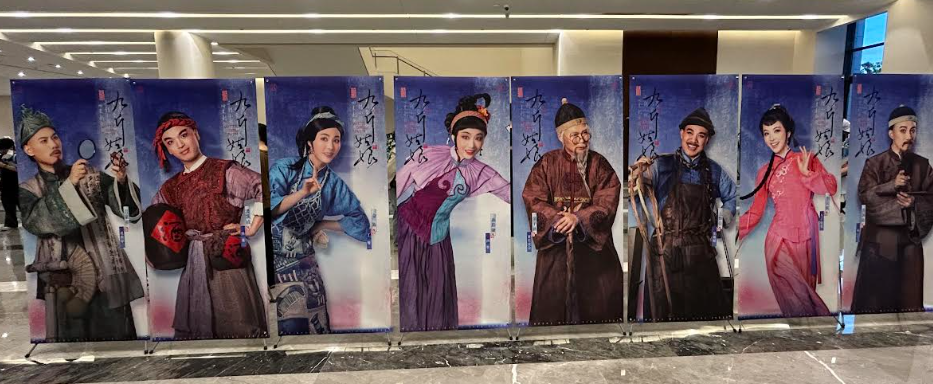
The Witty Girl Jiujin is a drama about a girl named Jiujin Zhang, who is the daughter of barrel maker Master Zhang. She is a kind and clever girl loved by everyone in her neighbourhood. One of the landlords, called Shi Er, is a tricky man who enjoys taking advantage of others and speaks in riddles rather than directly. He fools the neighbours into a deal where they have to answer his riddles correctly; if they are unsuccessful, they have to give up lots of precious items from their stalls. As Jiujin doesn’t want to see the businesses of her neighbours fail, she helps them answer his riddles. Shi Er notices Jiujin’s attempt to help her community and admires her talent. Because his two daughters-in-law are unreliable and argue with others often, Shi Er visits Jiujin and chooses her to be his third daughter-in-law in charge of managing his household.
Shi Er also invites Jiujin’s father to help him coop 10 buckets but attempts to trick him. Instead of saying the names of the buckets directly, Shi Er gives this information in an intentionally confusing and misleading way. Master Zhang gives an excuse to the landlord, goes back home, and asks Jiujin to help him using her genius.
At the same time, Shi Er’s remaining daughters-in-law argue and fight each other as they both desire to manage the household independently. In the middle of their fight, they accidentally kill the cat of a mean and nasty neighbour, the vicious Third Aunt. Shi Er wants to pay the Third Aunt to try and resolve the mistakes of his daughters-in-law, but because she claims that her cat is precious and unusual, she demands a huge amount of money back. Shi Er doesn’t want to pay this large sum of money as he believes that the Third Aunt’s cat is merely an ordinary cat, and so in an attempt to avoid paying it, he asks the Clan Elder for help. The Clan Elder refuses to help him because he knows about his history of tricking others in the neighbourhood and his cunning personality. The story ends with Jiujin hearing about this news and, in her final act of wisdom, she solves the problem using the same method used by the vicious Third Aunt. It is because of her wit, cleverness and intuition that a peaceful atmosphere and social harmony is maintained in Wushi Street by the conclusion.
“It is apparent that these changes encouraged by policy are quickly forming another important chapter in the genre’s already diverse and fluctuating history.”
The Witty Girl Jiujin is regarded as a “living fossil” of Shaoxing Opera, and it was adapted from two connected folk plays – The Hoop-Making Story and The Quarrel Script. According to historical descriptions, a male troupe brought it to the Shanghai stage for the first time in 1917. This opera also revived many nearly-lost early Yue Opera tunes, such as Sigong Hediao, Ai’ai Diao, Yin’e Diao (south and north), Pinghu Diao, Sanwuqi Diao and the Lotus Ballad. The master Ruiying Lv, who established the Lv style, also performed The Witty Girl Jiujin frequently in her style, and this also contributed to the popularity of the drama. The Witty Girl Jiujin therefore remains a beloved performance piece in Shaoxing Opera even today.
Shaoxing Opera originally used the dialects of the Zhejiang province before it was spread and reformed in both Shanghai and other Wu Dialect Areas, but even before it moved beyond Zhejiang, operas in this genre were already being performed in a variety of different accents and dialects due to the very fact that Zhejiang’s dialect varies in each different block and city. Each and every person’s accent can be different in this province! This means that it is not only possible to hear the phonological changes in Shaoxing Opera with its own accents and compare these performances to those in Mandarin, but that we can also see the effects that different sociolinguistic factors (such as gender, age and geographical factors in the Zhejiang province) had upon performances in this genre.
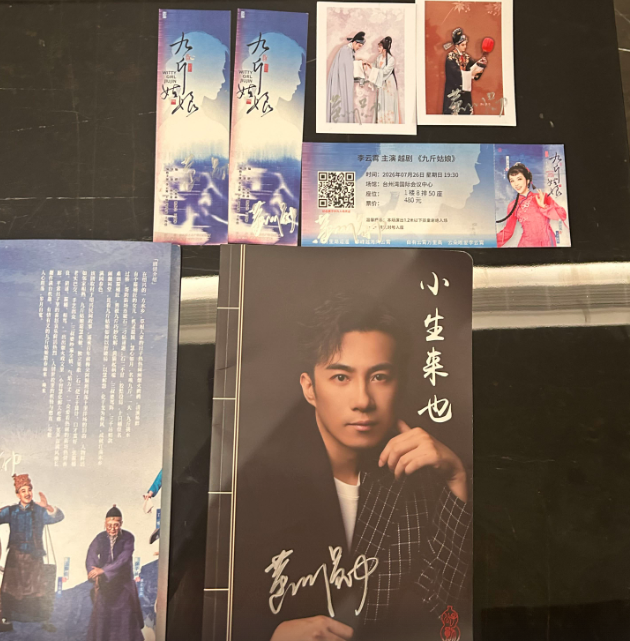
Shaoxing Opera also continues to be performed by both genders, though, as we know, the performers of this genre are still overwhelmingly female due to the fact that it was formally established by female masters. This being said, the Chinese government has created policies which encourage male performers to return to the stage and perform in order to promote equality, diversity and inclusivity as a feature of the current ‘youth’ operas. The Witty Girl Jiujin has two versions showing different generations of performers which reflect the changes that Shaoxing Opera has undergone as a genre. The most famous editions were adapted by the Zhe Jiang Xiaobaihua Yue Opera Troupe, and they are both performed by male and female actors at the same time. I have personally seen the latest youth version at the theatre, which cast award-winning actors and actresses such as Miss. Yunxiao Li, Chenxi Jiang, Liying Liu, Mr. Jianxun Huang, Zihan Xv, Weijia Wang, and more. The policies which have encouraged more male performers to participate in Shaoxing Opera have become a somewhat controversial topic; as the fan-base is overwhelmingly female, and as female masters and actresses have made Shaoxing Opera what it is today, many question whether men have a place in the genre at all. I am of the opinion that the encouragement of male performers in the participation of Shaoxing Opera has had a positive effect on the genre, opening it up to even more talent and potential. Whether you agree with the participation of male actors in Shaoxing Opera or not, it is apparent that these changes encouraged by policy are quickly forming another important chapter in the genre’s already diverse and fluctuating history.